
Pre Workout for Strength: A Dose-Smart Guide to Heavier, Better Lifting
Heavy lifting asks more of your nervous system than most people realise. This guide looks at how strength is built, why ingredient doses matter more than ingredient counts, and how to build a repeatable pre-lift routine, using InsaneGenix DART Extreme Pre-Workout as a worked example of a dosed formula.
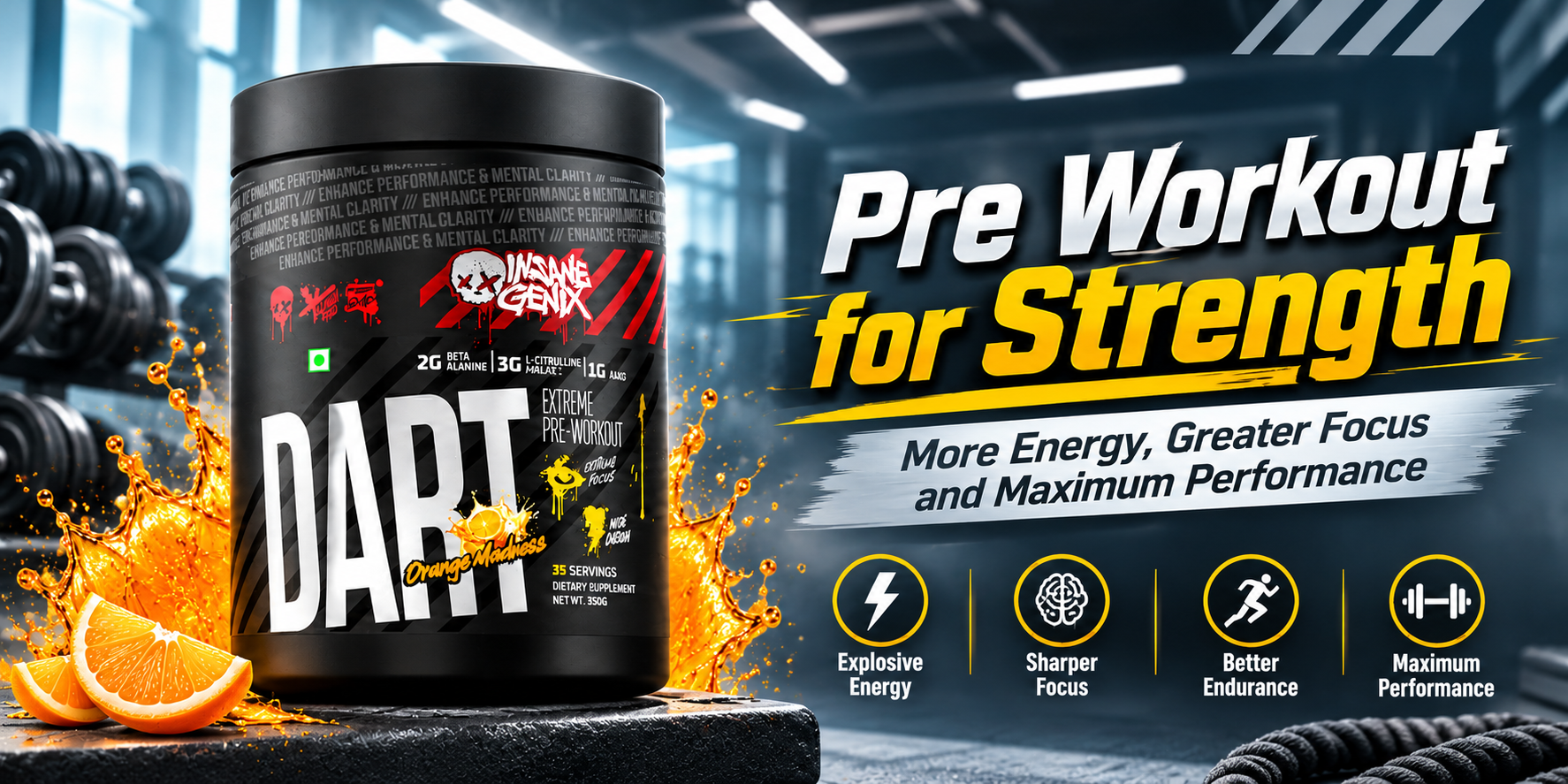
The bar is loaded to 100 kg. You have chalked up, set your feet and run through your cues, but the first rep feels slower than last week. Nothing hurts. Nothing is wrong. Yet the weight feels heavier than it should. Lifters in that spot often start researching a pre workout for strength, hoping for a quick fix. The truth is more interesting than a quick fix. Strength is the result of your nervous system, muscles, food, sleep and training plan working together. A supplement can only support one small corner of that picture, and only if you understand what is actually inside it. This guide takes a lifter’s view. We start with how force is produced, move to what pre workout ingredients are doing at the doses on the label, examine the formula of InsaneGenix DART Extreme, and finish with a routine you can repeat every session.
How Strength Actually Gets Made
Short answer: Strength is the ability to produce force, and it depends on both muscle size and how well your nervous system recruits that muscle. Training quality on the day decides how much stimulus you give both.
Force starts in the nervous system
When you squeeze a heavy deadlift off the floor, your brain sends signals to motor units, which are groups of muscle fibres controlled by one nerve. The harder the task, the more motor units you recruit and the faster they fire. This is why a beginner often gets stronger in the first weeks without visible muscle growth. Part of the early gain is simply learning to recruit what is already there.
Why training intensity matters
Small muscles of evidence aside, the principle is simple: to adapt, muscles need a challenge. Heavy sets close to your limit, done with good technique, provide that signal. If a set feels flat because you are tired, distracted or underprepared, you may leave quality reps on the table.
Motor unit recruitment in plain language
Think of a stadium with floodlights. Light loads switch on a few lights. Near-maximal loads need the whole stadium lit. Mental alertness and focus can influence how fully you commit to each heavy rep.
Immediate support versus long-term adaptation
A pre-workout is about the first idea: preparing you for today’s session. Real strength adaptation, the second idea, builds over weeks and months through progressive overload, protein, recovery and sleep. Keep those two apart in your mind and the rest of this guide makes more sense.
What Should a Pre Workout for Strength Actually Contain?
Short answer: Look for ingredients with a clear role in exercise preparation, listed at amounts you can read and compare. Here is what each commonly used ingredient is generally associated with.
Caffeine and workout performance
Caffeine is a stimulant widely studied for alertness and perceived effort. Research on exercise often uses doses scaled to body weight, so the same 200 mg does not feel identical to a 55 kg lifter and a 95 kg lifter. Your own tolerance matters more than any average.
Beta-alanine and high-intensity exercise
Beta-alanine is an amino acid your body uses to make carnosine, a compound that helps buffer acidity in working muscle. Studies on it usually involve daily intake over several weeks, so it is better seen as a gradual-support ingredient than a same-day boost. A harmless tingling sensation is common and does not indicate strength.
Citrulline malate and nitric oxide pathways
Citrulline is converted in the body to arginine, which is linked to nitric oxide pathways involved in blood flow. The 2:1 on a label means two parts citrulline to one part malate. It is most often discussed for endurance and higher-rep work, which still matters for the back-off sets in a strength programme.
Creatine and repeated high-intensity efforts
Creatine monohydrate is among the most researched supplements for short, powerful efforts such as heavy sets and sprints. Studies typically use daily amounts larger than what fits in one pre-workout scoop, so a pre-workout’s creatine content is best viewed as supportive rather than a full creatine plan.
AAKG and taurine
AAKG is an arginine compound often paired with citrulline in gym formulas. Taurine is an amino acid found naturally in muscle tissue and associated with normal muscle function and fluid balance. Both are supporting players, not stand-alone strength drivers.
Understanding ingredient dosages and formulation
Why doses matter more than counts
A label with fifteen ingredients is not automatically better than one with six. What counts is how much of each ingredient is present, and whether that amount lines up with what research has typically examined. Some ingredients at modest amounts are best seen as part of a blend; others at larger amounts do more of the work.
Three questions to ask of any label
- Are individual amounts listed, or hidden in a proprietary blend?
- How much caffeine is in one serving, and can I tolerate it?
- Does the serving size match how I train?
Ingredient
Primary role
Best understood as
Caffeine
Alertness and focus
Immediate, same-session
Citrulline malate / AAKG
Blood-flow pathways
Immediate to short-term
Beta-alanine
Muscle buffering
Gradual, builds with regular use
Creatine
High-intensity energy system
Gradual, builds with regular use
Taurine
Muscle function and fluid balance
Supportive
Inside DART Extreme: A Dose-by-Dose Read
With that framework in place, let us look at a real label. DART Extreme Pre-Workout from InsaneGenix lists its amounts openly, which makes it a useful example for reading doses.
Serving information
- Serving size: 10g
- Servings per container: 35
Ingredient breakdown and their potential roles
Ingredient
Per serving
General role
Beta-Alanine
2000 mg
Muscle buffering
L-Citrulline Malate 2:1
3000 mg
Nitric oxide pathways
AAKG
1000 mg
Arginine source
Taurine
1000 mg
Muscle function support
Creatine Monohydrate
1000 mg
High-intensity energy system
Caffeine Anhydrous
200 mg
Alertness and focus
Citrus Aurantium
50 mg
Stimulant-type extract
Theobromine
50 mg
Milder stimulant compound
Niacinamide
16 mg
Vitamin B3 form
Piper Nigrum
20 mg
Black pepper extract
Vitamin B6
2 mg
Normal energy metabolism
What the numbers suggest
The formula is built around three themes: alertness (caffeine, theobromine, citrus aurantium), blood-flow and endurance support (citrulline malate, AAKG, beta-alanine, taurine) and a creatine component for high-intensity work. For a 70 kg lifter, 200 mg of caffeine works out to roughly 2.9 mg per kg, which many people would consider a moderate amount, although tolerance varies widely. It is also worth being plain about what the numbers do not say. Several ingredient amounts, such as creatine and beta-alanine, are smaller per serving than the daily amounts typically used in studies of those ingredients. The research is on the ingredients, not on this specific product, and no product can promise strength gains.
How the formula fits into a weight-training routine
A formula like this is designed to be taken shortly before training. For lifters who already eat, sleep and train consistently, it can be one tool for preparing mentally and physically. You can read the complete label on the page for DART Extreme Pre-Workout.
Three Lifters, Three Setups
The examples below are illustrative scenarios, not testimonials. The beginner: building the habit first Aman is three months into a basic squat, press and row routine. His biggest gains will come from learning technique, eating enough and sleeping well. For him, a supplement is optional, and if he tries one he should start by checking his caffeine tolerance. The intermediate lifter: chasing quality sets Riya trains four days a week and stalls on the bench press. Her warm-up is rushed and her lunch is often skipped. Fixing those two habits may help more than any scoop, but a well-dosed pre-workout could suit her heavier sessions. The advanced lifter: managing small margins Kabir has trained for years. Progress is slow, so details matter: sleep, total caffeine, session timing. He benefits most from a formula whose doses he can read and compare, and from using it only on demanding days. The Pre-Lift Routine: Five Repeatable Steps Short answer: The best preparation is a short, repeatable sequence you do the same way before every heavy session.
- Eat a balanced meal containing carbohydrates and protein two to three hours before.
- Drink water steadily through the afternoon.
- Warm up with mobility work, then ramp-up sets.
- Take your pre-workout 20 to 30 minutes before training, if you use one.
- Log your first working set so you can compare it next week.
Warm-up techniques before lifting
Start with five minutes of light cardio, then joint mobility for the muscles you are about to use. Follow with progressive sets: for a 100 kg squat, you might go bar only, 40 kg, 60 kg, 80 kg and then 90 kg before working sets.
Nutrition and hydration before training
Carbohydrates supply training fuel, and protein supports repair. Even mild dehydration can make lifting feel harder, so do not rely on the shaker bottle as your only fluid.
Timing your pre-workout intake
Follow the product directions. For DART Extreme, mix one level scoop (about 10g) with 200 to 250 ml of cold water, shake for 20 to 30 seconds, and drink it 20 to 30 minutes before training. Do not exceed the recommended serving.
Common pre-workout mistakes to avoid
- Taking extra scoops because a session feels heavy.
- Forgetting caffeine from coffee, tea or energy drinks.
- Training late in the evening and losing sleep.
- Skipping warm-up sets because the supplement “will cover it”.
What Happens Between Sessions Matters More
Strength is built in the days after the workout, not the minutes before it. This is the part of the story that no scoop can replace.
Progressive overload and consistent training
Progressive overload means gradually asking your body to do a little more over time: an extra rep, a small weight increase, or an additional set. Consistency over months beats occasional heroic sessions.
Recovery, sleep and muscle adaptation
Muscles adapt while you rest. Seven to nine hours of sleep, enough protein and sensible rest days give your body time to respond to the stimulus you created.
How to track your strength progress
What to log
Record your main lifts, sets, reps and load. Add a quick note on sleep and how the session felt. A simple weekly check Once a week, compare your best set of each main lift with the previous week. Look at trends over four to six weeks instead of reacting to one bad day.
Safety Considerations and Responsible Supplement Use
Understanding caffeine sensitivity
People react to stimulants very differently. Restlessness, jitters, a racing heart or poor sleep may signal that a dose is too high for you. Always read the ingredient list before using any product.
Who should check first or avoid stimulant-based pre-workouts?
According to its product safety information, DART Extreme is not intended for individuals under 18. Anyone with a medical condition, anyone taking medication, and people who are pregnant or breastfeeding should consult a qualified healthcare professional before use.
Why individual tolerance matters
Total daily caffeine
Add up caffeine from every source in your day, not just the shaker. A practical test Try a new product on a lighter training day first, so you learn how your body responds before a heavy session.
Frequently Asked Questions About Pre Workout for Strength
Does a pre-workout increase strength?
It may support alertness and training preparation for some people, but strength gains come from progressive training, nutrition and recovery.
What is the best time to take pre-workout before lifting?
Most formulas, including DART Extreme, are taken about 20 to 30 minutes before training.
Which ingredients are most relevant for heavy lifting?
Caffeine, creatine, citrulline malate and beta-alanine are commonly discussed, each with different roles and timelines.
How much caffeine is in DART Extreme Pre-Workout?
Each 10g serving contains 200 mg of caffeine anhydrous, along with 50 mg of theobromine and 50 mg of citrus aurantium.
Is pre-workout safe for beginners?
Healthy adults can use it, but beginners should check tolerance, start carefully and focus first on technique, food and sleep.
Can I use pre-workout every training day?
That depends on your tolerance and total caffeine intake. Many lifters reserve it for harder sessions. If unsure, ask a healthcare professional.
Is creatine in pre-workout enough?
The amount in a pre-workout serving is often lower than daily amounts used in studies, so it is best seen as a supporting ingredient.
What should I eat before heavy lifting?
A balanced meal with carbohydrates and protein two to three hours before, or a light snack such as a banana closer to the session.
Do I need pre-workout to get stronger?
No. Progressive overload, enough protein and calories, and good sleep are the foundations. A supplement is optional.
Can pre-workout replace a warm-up?
No. A proper warm-up prepares joints, muscles and technique. A supplement does not do that.
Final Thoughts
Strength is a long game. It rewards the lifter who warms up properly, eats well, sleeps enough, tracks progress and adds load patiently. A well-chosen pre workout for strength can be a useful part of that routine, but it is the habits around it that do the heavy lifting. If you are researching formulas, review the complete label of InsaneGenix DART Extreme Pre-Workout, compare each dose with your own training and tolerance, and use it responsibly. Then get back under the bar and make the next rep count.
View more blogs
Best Pre Workout Muscle Growth – Blog
A pre-workout will not build muscle by itself, but the right one helps you train harder, longer and sharper. This guide explains the four jobs a muscle-growth pre-workout must do, checks real ingredient doses, and shows how InsaneGenix DART Extreme fits into a smart training plan.
Read article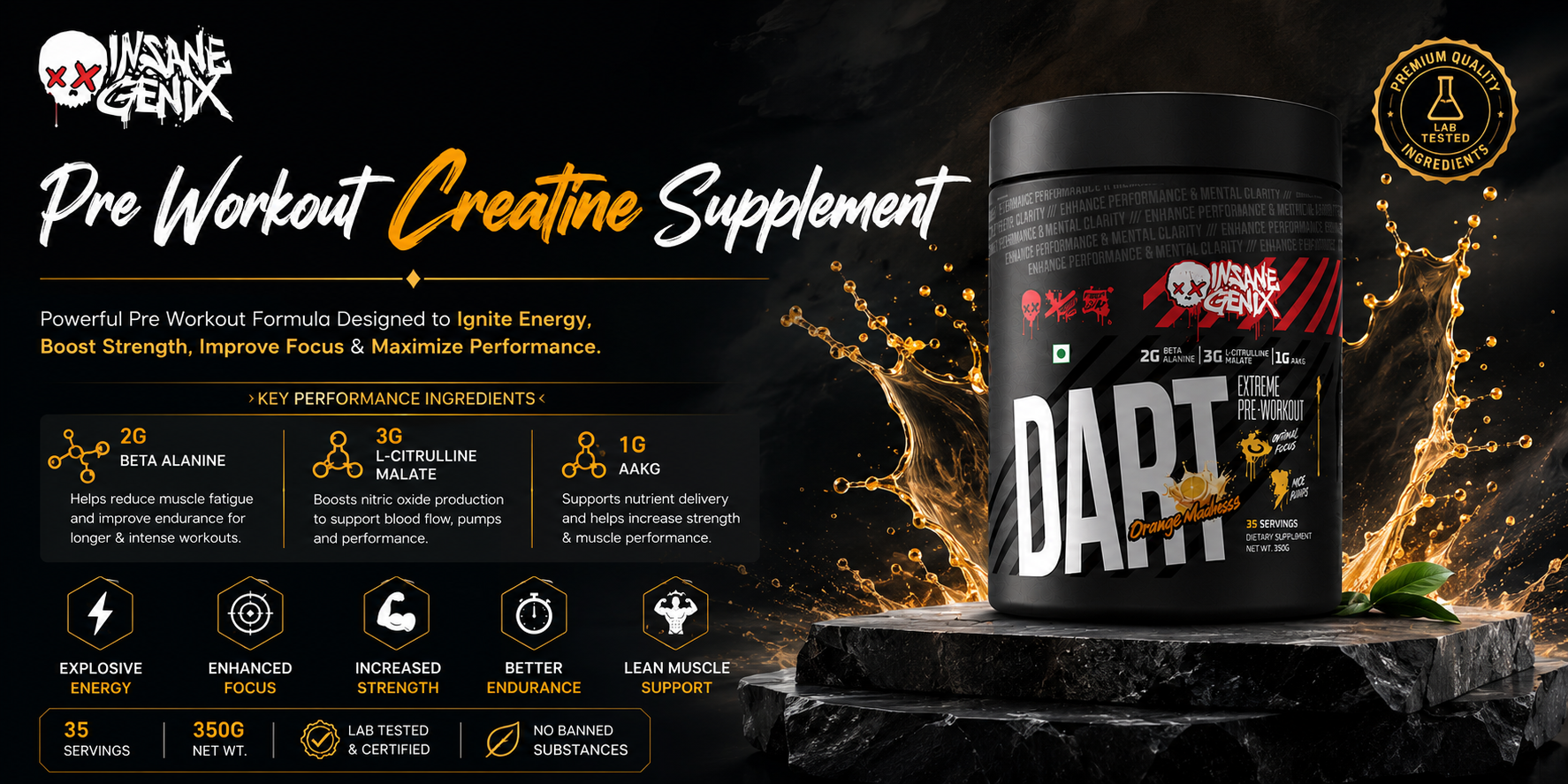
Pre Workout Creatine Supplement: What the Science Says and How to Use It Wisely
Creatine is one of the most researched performance supplements in the world, and many pre-workouts now include it. This article explains how creatine works, why daily consistency matters more than timing, what dose to aim for, and how the 1 g of creatine in DART Extreme Pre-Workout by InsaneGenix fits into a complete plan.
Read article
Best Workout Booster Supplement: A Practical Buyer's Guide for Everyday Lifters
A workout booster supplement should help you show up with energy, train with intent and recover well enough to repeat the effort tomorrow. This guide walks through real-life gym situations, a five-question buying test, ingredient explanations and a clear look at DART Extreme Pre-Workout by InsaneGenix, so you can decide with confidence.
Read article